Friday, 6 March 2015

Torture Impunity and Police Shootings


A danger from the “war on terror” was always that it would encourage the spread of an authoritarian U.S. state, ignoring international law abroad and constitutional rights at home, a process that is now growing more apparent with impunity for both torturers and police who kill minorities...

The international fallout from last week’s long-delayed release of the Senate Intelligence Committee’s 500-page executive summary of its still-classified 6,000 report on CIA torture could hardly be more intense, with calls coming from the United Nations, foreign governments and the human rights community for prosecutions of those who carried out or authorized the torture techniques described in the report, including senior officials from the Bush administration.
But judging from the self-assured comments of CIA and former administration officials, there is no real concern over the possibility of any criminal liability, a lack of accountability which has led to a palpable arrogance among those who would be behind bars if laws were actually enforced on an equal basis in the United States.
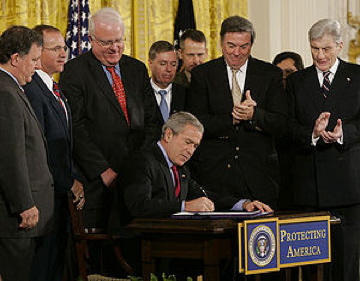
President George W. Bush signing Military Commissions Act of 2006.
The above-the-law sense of entitlement was perhaps most clearly on display in former Vice President Dick Cheney’s appearance this Sunday on “Meet the Press,” stating that when it comes to using torture, “I’d do it again in a minute.”
When presented with gruesome details from the Senate report on torture – for example the newly revealed “enhanced interrogation technique” of “rectal feeding,” i.e., anal rape – and asked for his definition of what might constitute “torture” in a legal sense, Cheney retorted that torture is “an American citizen on his cellphone making a last call to his four young daughters shortly before he burns to death in the upper levels of the Trade Center in New York on 9/11.”
Short of this rather high bar, nothing, by definition, that the United States does to its detainees could conceivably be considered torture.
Similarly, when asked about the large number of innocent people (26 out of 119 CIA detainees, according to the report) who had tragically been detained and tortured in error, for example Gul Rahman – a victim of mistaken identity who was chained to the wall of his cell, doused with water and froze to death in CIA custody – Cheney stated indifferently that these individuals essentially don’t matter in the grand scheme of things. The only problem that Cheney had was “with the folks that we did release that end up back on the battlefield.”
“I’m more concerned with bad guys who got out and released than I am with a few that, in fact, were innocent,” he said. Taken to its logical conclusion, Cheney’s reasoning would seem to hold that it is preferable to indefinitely detain and torture a million innocent people than to allow one “bad guy” to slip through the cracks. The implications of this logic are, needless to say, chilling (not to mention completely at odds with the legal principle of presumed innocence).
A Courtroom Defense
At times, watching Cheney make these cold rationalizations on “Meet the Press,” it may have occurred to viewers that the more appropriate venue for this interview would have been on the witness stand of a courtroom. After all, what Cheney was defending was not just controversial policy choices, but clearly defined crimes of torture and murder.
Although he was sure to emphasize that “All of the techniques that were authorized by the President were, in effect, blessed by the Justice Department,” the fact remains that providing the cover of law to a crime makes it no less of a crime.
This is a point that UN Special Rapporteur on Human Rights and Counterterrorism Ben Emmerson specifically made last week following the release of the report. In a statement, Emmerson said, “The fact that the policies revealed in this report were authorized at a high level within the U.S. government provides no excuse whatsoever. Indeed, it reinforces the need for criminal accountability.”
Emphasizing that all individuals responsible for “the criminal conspiracy” described in the Senate report “must be brought to justice, and must face criminal penalties commensurate with the gravity of their crimes,” Emmerson noted that “international law prohibits the granting of immunities to public officials who have engaged in acts of torture.”
Judging from Cheney’s arrogant display on “Meet the Press,” however, there appears to be very little appreciation for the niceties of international law such as its expressed prohibition on official immunity when it comes to the crime of torture. He seems to be quite confident, indeed, that official immunity is unnecessary when there is an implied unofficial immunity that is granted to public officials in the United States, this being the case whether it pertains to CIA torture or police brutality.
Police Shootings
The same arrogance that Cheney is so casually displaying can also be seen in the closely paralleled story of the recent spate of police shootings and killings of innocent or unarmed African-Americans, and the remarkable wave of demonstrations that has taken hold across the United States in response.
With large-scale protests happening in most major American cities over the past month – particularly since grand juries decided not to indict the police officers who killed Michael Brown in Ferguson, Missouri, and Eric Garner in New York City – one might think that cops would be extra careful these days not to come across overly arrogant or obdurate. This, however, would not be the case.
In response to the NFL’s Cleveland Browns’ wide receiver Andrew Hawkins taking the field on Sunday wearing a T-shirt protesting recent police shootings in Ohio – reading “Justice for Tamir Rice and John Crawford” on the front and “The Real Battle for Ohio” on the back – Jeff Follmer, president of the Cleveland police union, claimed the shirt was disrespectful and he disparaged the very idea of athletes holding opinions about anything other than sports.
“It’s pretty pathetic when athletes think they know the law,” Follmer said in a statement. “They should stick to what they know best on the field.” In other words, keep your opinions to yourself, boy, and just play football. Follmer also demanded an apology from the Clevelend Browns organization, which to their credit, the Browns did not extend.
Instead, the Browns fired back with a statement saying the organization endorses the rights of players “to project their support and bring awareness to issues that are important to them if done so in a responsible manner.”
Hawkins also weighed in with comments to the media that revealed, in fact, a deep knowledge and understanding of what law and justice mean (or should mean), contrary to Follmer’s condescending remarks. “Justice,” he said, “is a right that every American should have. Justice means that the innocent should be found innocent. It means that those who do wrong should get their due punishment.”
His six-minute locker-room monologue to reporters ended with him choking up while drawing a parallel between his own young son and the tragic death of Tamir Rice, the 12-year-old boy shot by police in Cleveland on Nov. 22 while holding a toy gun.
“My number one reason for wearing the T-shirt was the thought of what happened to Tamir Rice happening to my little Austin. And that scares the living hell out of me,” he said.
Protests and Fears
This genuine, personal fear of police violence is one that has been widely expressed over the last several weeks of protests taking hold across the country. As Democracy Now’s Aaron Maté reported from New York’s “Millions March” on Saturday, one of the dominant themes being expressed on the streets was “a sense of not feeling safe, not feeling safe themselves and not feeling safe for their loved ones, people of color in heavily policed communities.”
Interviewing protester Darrell Greene, Maté asked him to explain his sign, which read “Me, my father, my son. Who’s next?”
Greene responded, “At this point, I know I’m a productive citizen, and I don’t feel safe in my own community. I’ve never been in trouble with law enforcement. And from what I’m seeing on the news and what’s been going on, I really wonder: Am I next? I’m wondering if the people in my community are next. We’re all productive citizens, and we’re in fear for our life. We feel like it’s open season on all minorities, and we want to know if we’re really safe.”
Protester Nilan Johnson echoed these sentiments. “I’m here because Americans, period, are being preyed on, right now,” he said. “African-Americans are once again fighting for the right to be human, and I think that’s horrible.”
Asked whether he feels, as a person of color, whether he is unsafe in his community, Johnson replied, “That’s – I feel that daily, so I feel that’s a preconditioned nature now. I feel threatened and marked and cornered. And everybody here feels the same way. And we’re trying to keep our humanity.”
If not a direct byproduct of the war on terror’s excesses and the impunity that law-breakers at the highest levels of government enjoy, this feeling of powerlessness, insecurity and injustice is certainly closely related. Indeed, as far back as 2007, civil rights leaders were drawing these connections, in particular in a report prepared for the United Nations entitled “In The Shadows Of The War On Terror: Persistent Police Brutality and Abuse of People of Color in the United States.”
Since 9/11, the report explained, “there have been dramatic increases in law enforcement powers in the name of waging the ‘war on terror,’” while simultaneously, counter-terrorism policies have “created a generalized climate of impunity for law enforcement officers, and contributed to the erosion of what few accountability mechanisms exist for civilian control over law enforcement agencies.”
This has led to an erosion of public discussion and accountability with respect to the use of excessive force against people of color, while at the same time, “systemic abuse of people of color by law enforcement officers has not only continued since 2001 but has worsened in both practice and severity,” according to the report. As a representative of the NAACP put it, “the degree to which police brutality occurs … is the worst I’ve seen in 50 years.”
Troubling Trend
Even establishment publications such as the Wall Street Journal have noticed the troubling trend of rising police violence and its connections with the war on terror. As a feature article in WSJ put it in August 2013, “the war on drugs and, more recently, post-9/11 antiterrorism efforts have created a new figure on the U.S. scene: the warrior cop – armed to the teeth, ready to deal harshly with targeted wrongdoers, and a growing threat to familiar American liberties.”
This threat to liberties is compounded when the justice system fails to hold accountable those who break the law and violate people’s rights. Whether it is Eric Garner in New York or Gul Rahman in Afghanistan, the victims of injustice must have redress, and “those who do wrong should get their due punishment,” in the words of Cleveland Browns wide receiver Andrew Hawkins.
As human rights advocates and civil libertarians have warned since the early days of the “war on terror,” human rights violations of terror suspects will eventually set the United States on a slippery slope in which authorities deem it optional whether to respect the human rights of anyone, including U.S. citizens. At that point, anyone is fair game, and all of us, including law-abiding Americans, may find ourselves at the mercy of an unsympathetic authoritarian state.

Thursday, 5 March 2015

Only mass default will end the world's addiction to debt

The world is sinking under a sea of debt, private as well as public, and it is increasingly hard to see how this might end, except in some form of mass default.
Greece we already know about, but the coming much wider outbreak of debt repudiation will not be confined to sovereign nations. Last week, there was another foretaste of what’s to come in developments at Austria’s failed Hypo Alpe-Adria-Bank International . Taxpayers have had enough of paying for the country’s increasingly crisis-ridden banking sector, and have determined to bail in private creditors to the remnants of this financial road crash instead - to the tune of $8.5bn in the specific case of Hypo Alpe-Adria. Finally, creditors are being made to pay for the consequences of their own folly.
You might have thought that a financial crisis as serious as that of the past seven years would have ended the world economy’s addiction to debt once and for all. It has not. If anything, the position has grown even worse since the collapse of Lehman Brothers.
According to recent analysis by McKinsey Global Institute, global debt has increased to the tune of $57 trillion, or 17pc, since 2007, with little sign of a slowdown in sight. Much of this growth has been in emerging markets, which were comparatively unaffected by the financial crisis. Yet even in the developed West, private sector deleveraging has been limited and, in any case, more than outweighed by growing public indebtedness. The combined public sector debt of the G7 economies has grown by 40pc to around 120pc of GDP since the crisis began. There has been no overall deleveraging to speak of.
Where the West left off, Asia has taken up the pace, with a credit-induced real estate bubble that makes its pre-crisis Western counterpart look tame by comparison, much of it fuelled, as in Western economies, by growth in the shadow banking sector.
China’s total indebtedness has quadrupled since 2007 to $28 trillion, according to estimates by McKinsey. At 282pc of GDP, the debt burden is now bigger, relative to output, that the US.

READ MORE...

SHARE THIS ARTICLE...


Wednesday, 4 March 2015

Obama’s hypocritical stance on China’s plan to require backdoors in tech products

obama-quora-qa
President Obama wants China to know that the United States government is the only one that can ask Western tech companies to include backdoors in their consumer products.
Obama told Reuters that China’s mandates “would essentially force all foreign companies, including U.S. companies, to turn over to the Chinese government mechanisms where they can snoop and keep track of all the users of those services.” That, obviously, would be bad.
But the most telling part of the interview came from Obama’s remarks on tech companies’ willingness to hand over such access to a government — not a “foreign” government, just “a government” — despite increasing pressure to do so. As he explained to Reuters:
Those kinds of restrictive practices I think would ironically hurt the Chinese economy over the long term because I don’t think there is any U.S. or European firm, any international firm, that could credibly get away with that wholesale turning over of data, personal data, over to a government.
That’s interesting, considering the US has been attempting to gain such access to tech platforms for the last several years, and FBI Director James Comey has been lobbying to force tech companies to include backdoors in their consumer products. Sound familiar?

Those efforts prompted a group of Congressmen, led by Sen. Ron Wyden (D-Ore.), to introduce a bill that would prevent the FBI from requiring the creation of those backdoors.

READ MORE... 

SHARE THIS ARTICLE...

Tuesday, 3 March 2015

Bernanke Wants the U.S. President to Declare “Economic Emergencies” in Future Crises

Presidents should get the power to declare economic emergencies along the lines to declare war, said former Federal Reserve Chairman Ben Bernanke on Monday.
It might make sense to give “the president some ability to declare emergencies or take extraordinary actions and not put that all on the Fed,” Bernanke said at a conference. “The constitution gives the president significant flexibility to respond to military situations,” in part because they are chaotic, he noted.
“I am sure it is not politically possible, but it would be worth thinking about,” the former Fed chairman said.
For those of us who remain horrified and disgusted by the 2008-09 Federal Reserve and U.S. government bailout of the kleptocratic oligarchs who created the crisis, the above comments by the mastermind of this historic theft should be extremely concerning.
Although bankers and oligarchs got everything they wanted and more from the post crisis panic, what seems to bother Bernanke is that some of the response measures had to be pursued publicly. By calling for the U.S. President to declare economic emergencies in future crises, he is explicitly saying he doesn’t want Congress involved at all, even if just ceremonially. This man is a dyed in the wool fascist.

WASHINGTON (MarketWatch) — Presidents should get the power to declare economic emergencies along the lines to declare war, said former Federal Reserve Chairman Ben Bernanke on Monday.
While the Fed retains the authority it needs to respond to another financial crisis, financial crises “tend to have a certain chaotic element to them,” that no one can predict, Bernanke said during a panel discussion sponsored by The Hutchins Center on Fiscal and Monetary Policy.
In light of this, it might make sense to give “the president some ability to declare emergencies or take extraordinary actions and not put that all on the Fed,” Bernanke said at a conference. “The constitution gives the president significant flexibility to respond to military situations,” in part because they are chaotic, he noted.
“I am sure it is not politically possible, but it would be worth thinking about,” the former Fed chairman said.
After the House initially rejected the proposal and stock markets tumbled, Congress reconsidered and the measure was signed into law and became the $700 billion Troubled Asset Relief Program, or TARP.
After coming across the above, I got to thinking about the process for declaring national emergencies. I performed a quick search and read a little bit about the National Emergencies Act of 1976. It was passed in response to a spate of national emergencies initiated by President Richard Nixon, and was intended to ensure Congress exerted more oversight on such declarations for obvious reasons.
Unsurprisingly, Congress hasn’t been doing its job. As USA Todaypointed out in a special report last year:
The 1976 law requires each house of Congress to meet within six months of an emergency to vote it up or down. That’s never happened.
Here are some additional excerpts:
In his six years in office, President Obama has declared nine emergencies, allowed one to expire and extended 22 emergencies enacted by his predecessors.
Since 1976, when Congress passed the National Emergencies Act, presidents have declared at least 53 states of emergency — not counting disaster declarations for events such as tornadoes and floods, according to a USA TODAY review of presidential documents. Most of those emergencies remain in effect.
Even as Congress has delegated emergency powers to the president, it has provided almost no oversight. The 1976 law requires each house of Congress to meet within six months of an emergency to vote it up or down. That’s never happened.
In May, President Obama rescinded a Bush-era executive order that protected Iraqi oil interests and their contractors from legal liability.Even as he did so, he left the state of emergency declared in that executive order intact — because at least two other executive orders rely on it.
Seriously?
Invoking those emergencies can give presidents broad and virtually unchecked powers. In an article published last year in the University of Michigan Journal of Law Reform, attorney Patrick Thronson identified 160 laws giving the president emergency powers, including the authority to:
• Reshape the military, putting members of the armed forces under foreign command, conscripting veterans, overturning sentences issued by courts-martial and taking over weather satellites for military use.
• Suspend environmental laws, including a law forbidding the dumping of toxic and infectious medical waste at sea.
• Bypass federal contracting laws, allowing the government to buy and sell property without competitive bidding.
• Allow unlimited secret patents for Army, Navy and Air Force scientists.
All these provisions come from laws passed by Congress, giving the president the power to invoke them with the stroke of a pen. “A lot of laws are passed like that. So if a president is hunting around for additional authority, declaring an emergency is pretty easy,” Scheppele said.
 
 After President Richard Nixon declared two states of emergency in 17 months, Congress became alarmed by four simultaneous states of emergency.
It passed the National Emergencies Act by an overwhelming majority, requiring the president to cite a legal basis for the emergency and say which emergency powers he would exercise. All emergencies would expire after one year if not renewed by the president.
Bush’s Proclamation 7463 provides much of the legal underpinning for the war on terror. Bush cited that state of emergency, for example, in his military order allowing the detention of al-Qaeda combatants at Guantanamo Bay, Cuba, and their trial by military commission.
The post-9/11 emergency declaration is in its 13th year. Eleven emergencies are even older.
The National Emergencies Act allows Congress to overturn an emergency by a resolution passed by both houses — which could then be vetoed by the president. In 38 years, only one resolution has ever been introduced to cancel an emergency.
Congress, useless as usual. Unless of course a corporate giveaway is crafted by lobbyists, in which case it flies through both chambers and becomes law instantaneously.
After Hurricane Katrina in 2005, President Bush declared a state of emergency allowing him to waive federal wage laws. Contractors rebuilding after the hurricane would not have to abide by the Davis-Bacon Act, which requires workers to be paid the local prevailing wage.
“The history here is so clear. The Congress hasn’t done much of anything,” said Harold Relyea, who studied national emergencies during a 37-year career at the Congressional Research Service. “Congress has not been the watchdog. It’s very toothless, and the partisanship hasn’t particularly helped.”
If anything, Congress may be inclined to give the president additional emergency powers. Legislation pending in Congress would allow the president to invoke an emergency to waive liability for health care providers and to sanction banks that do business with Hezbollah.
Scheppele, the Princeton professor, said emergencies have become so routine that they are “declared and undeclared often without a single headline.”
Bernanke may be a kleptocratic oligarch criminal, but stupid he is not. He knows exactly what kind of power an “economic emergency” would grant to the executive, which is exactly why he wants it to happen.

A Republic or Democracy this is not.  

SHARE THIS ARTICLE...

Monday, 2 March 2015

Fla. police chief busted in threeway sex-for-hire sting

Miami Gardens Police Chief Stephen Johnson, who was fired Friday night and released from jail Saturday morning, did not deny the charges to waiting reporters.
"The stress overwhelmed me," he said, "and I made a very bad decision."
The 53-year-old Johnson, who was hired last May, was arrested Friday evening on a charge of soliciting a prostitute in Dania Beach, the Miami Herald reports.
Michael Wright, a detective and police department spokesman, said Johnson was arrested at a motel during a sting operation conducted by the Broward County Sheriff's Office.
According to the arrest report, Johnson first spoke by phone with the undercover officer who told him a 30-minute session would cost $60, but he struck a deal for two women for $100.
He then showed up at the motel and was arrested after giving her $100.
At Miami Gardens, a town of around 100,000 located between Miami and Fort Lauderdale, Johnson, formerly the police chief and city manager of North Miami, supervised a department of around 200 officers.
Cameron Benson, Miami Gardens city manager, told the Sun-Sentinel that he fired Johnson immediately upon learning of his arrest.
"It was one of the most painful things I've ever heard as a manager," Benson told the newspaper. "To hear that type of news, it's like a punch in the stomach. It was something that I just couldn't fathom that was being told to me."

READ MORE...

SHARE THIS ARTICLE...

Sunday, 1 March 2015

Total Mainstream Media Blackout of Chicago Secret ‘Black Site’ at Homan Square

Chicago, IL — As the nation continues to react to the newly discovered ‘black site’operated by Chicago Police, the mainstream media continues to bury it’s head in the sand.
National media outlets like Fox, MSNBC, and CNN are unsurprisingly refusing to touch this story, driving even further suspicion that the corporate media has become nothing more than a mouthpiece for big government and corporate America.
As we reported earlier this week, local corporate media was literally running stories about Homan Square that were direct copies from CPD’s public relations statements.
According to interviews conducted by The Atlantic, local mainstream reporters often agree with these disappear and torture tactics, so they refuse to do their jobs at uncovering what is going on there;
“I think that many crime reporters in Chicago have political views that are right in line with the police,” Tracy Siska said. “They tend to agree about the tactics needed by the police. They tend to have by one extent or the other the same racist views of the police — a lot of urban police (not all of them by any stretch, but a lot of them) embody racism.”
Meanwhile, a campaign we launched to shed light on Homan Square, #Gitmo2Chicago, trended nationwide last night on Twitter and today on Facebook — showing that the public at large is generally disgusted by these CIA-style tactics.
So while the corporate media posts 3 million stories about the color of a dress, the country is questioning the police state in a big way.
As I write this, a large protest is taking place in Chicago at Homan Square to shut it down, with more protests being planned across the country in the coming weeks.
But keep in mind, the Revolution will not be televised on Cable TV, but it will be on the internet. Watch live video from the protests here.

SHARE THIS ARTICLE...

Google modifying algorithm in attempt to become the Internets Ministry of Truth

Google is looking at rolling out yet another revision to their search engine algorithm by curtailing your results to sites it considers to be the most "trustworthiness." 

New Scientist Explains:
Google's search engine currently uses the number of incoming links to a web page as a proxy for quality, determining where it appears in search results. So pages that many other sites link to are ranked higher. This system has brought us the search engine as we know it today, but the downside is that websites full of misinformation can rise up the rankings, if enough people link to them.
A Google research team is adapting that model to measure the trustworthiness of a page, rather than its reputation across the web. Instead of counting incoming links, the system – which is not yet live – counts the number of incorrect facts within a page. "A source that has few false facts is considered to be trustworthy," says the team (arxiv.org/abs/1502.03519v1). The score they compute for each page is its Knowledge-Based Trust score.
...
The software works by tapping into the Knowledge Vault, the vast store of facts that Google has pulled off the internet. Facts the web unanimously agrees on are considered a reasonable proxy for truth. Web pages that contain contradictory information are bumped down the rankings.
LazyTruth developer Matt Stempeck, now the director of civic media at Microsoft New York, wants to develop software that exports the knowledge found in fact-checking services such as Snopes, PolitiFact and FactCheck.org so that everyone has easy access to them. He says tools like LazyTruth are useful online, but challenging the erroneous beliefs underpinning that information is harder. "How do you correct people's misconceptions? People get very defensive," Stempeck says. "If they're searching for the answer on Google they might be in a much more receptive state." 

SHARE THIS ARTICLE...